
Project scientists are also carrying out several additional enhanced weathering trials.

Aim: Determine the effect of crushed basalt application on carbon dioxide capture, soil properties and crop yield in a rainfed sugarcane farming system in the Humid Tropics.
Duration: 2018-2025
Leaders: Dr Paul Nelson and Fred Holden
Funding: Leverhulme Centre for Climate Change Mitigation, James Cook University
Experimental design: Farm at Gordonvale. Treatments are 0, 20 or 50 t/ha of basalt applied from 2018 to 2024, plus 0 or 2.5 t/ha of lime superimposed on the 0 and 50 t/ha basalt treatments from 2022 to 2024. Four replicate plots, each 550 x 8.25 m.
Results: Results of the first 5 years are available in the paper by Holden et al. (2024). Results of the subsequent 3 years are being prepared for publication.

Aim: Determine the effect of crushed basalt application on carbon dioxide capture, soil properties and crop yield in an irrigated sugarcane farming system in the Dry Tropics.
Duration: 2018-2025
Leader: Dr Paul Nelson and Fred Holden
Funding: Leverhulme Centre for Climate Change Mitigation, James Cook University
Experimental design: Farm at Dimbulah. Treatments are 0, 20 or 50 t/ha of basalt applied from 2018 to 2020. Four replicate plots, each ~300 x 8.25 m.
Results: Results are being analysed.

Aim: Determine the effect of crushed basalt application and soil management practices on carbon dioxide capture, soil properties and crop yield in rainfed sugarcane in the Humid Tropics.
Duration: 2024-2026
Leader: Dr Paul Nelson and Sofonyas Dargie Tefera
Funding: UNDO, James Cook University
Experimental design: Plot trial on James Cook University Nguma bada campus in Cairns. Treatments are 0, 20 or 50 t/ha of basalt, with four different management practices imposed on the 0 and 50 t/ha treatments. Six replicate plots, each 4 x 3 m.
Results: Results are being analysed.

Aim: Determine the effect of crushed basalt application on carbon dioxide capture, soil properties and pasture growth yield in a grazed savanna in the Dry Tropics.
Duration: 2024-2027
Leaders: Dr Paul Nelson and Dr Amanda Neilen
Funding: Consolidated Pastoral Company, James Cook University
Experimental design: Plot trial on Consolidated Pastoral Company Station near Chillagoe. Treatments are 0 or 100 t/ha of basalt applied in 2024. Six replicate plots, each 6 x 6 m.
Results: Results are being analysed.

Aim: Determine the effect of sugar mill by-products (mud and ash) on carbon dioxide capture, soil properties and crop yield in rainfed sugarcane in the Humid Tropics.
Duration: 2022-2025
Leaders: Dr Paul Nelson and Hannah Green
Funding: Sugar Research Australia, James Cook University
Experimental design: Farm at Ingham. Treatments are 50 t/ha mill mud, 100 t/ha mill ash, 50 t/ha mill mud + 100 t/ha mill ash, or 0 t/ha of mill by-products, applied once in late 2022. Six replicate plots each 15 x 4.5 m.
Results: Results are being analysed.
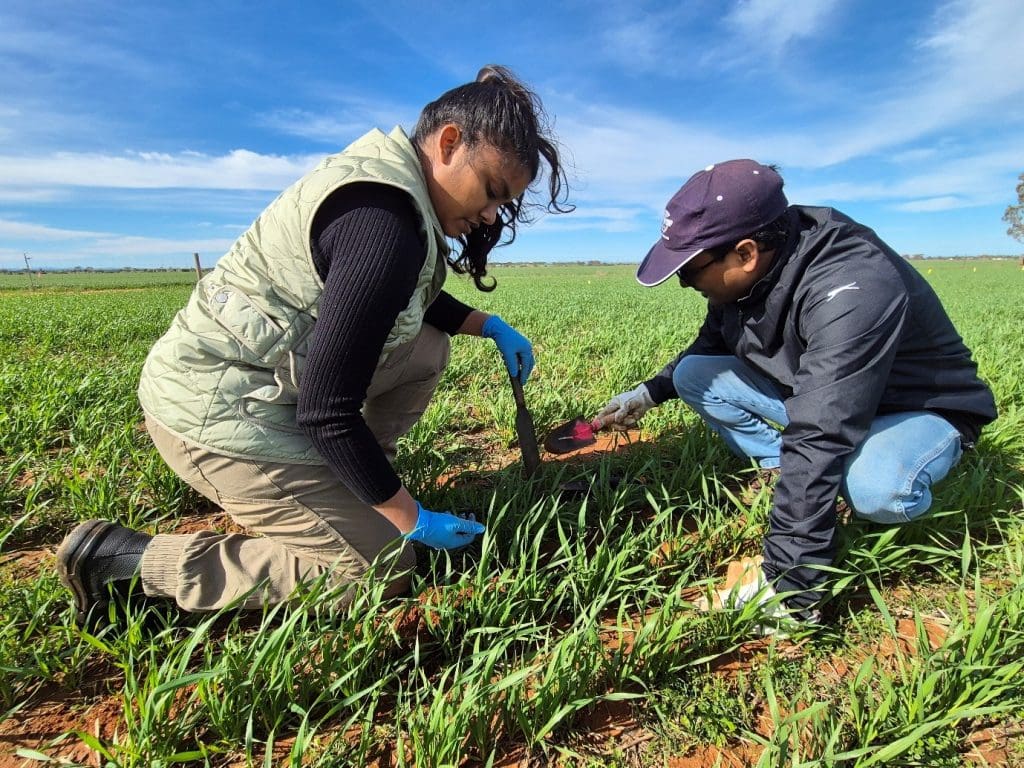
Aim: Determine the effect of crushed basalt application on soil properties, crop performance and carbon dioxide capture in an acidic sandy loam soil under wheat crop receiving varying rates of urea fertiliser.
Duration: established May 2025
Leaders: Dr Binoy Sarkar and Thilini Amarasinghe
Funding: Adelaide University (previous University of South Australia)
Soil: Acidic reddish-brown sandy loam classified as a Red Sodosol.
Experimental Design: Trial site at Mallala, South Australia. Treatments of two basalt rates at 20 and 40 t/ha combined with two urea fertiliser rates of 50 and 100 kg/ha with appropriate controls in a split-plot design with four replicates. Plot size 3 x 10 m.
Results: Results are being analysed.