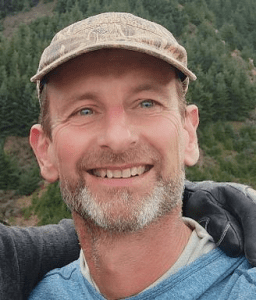
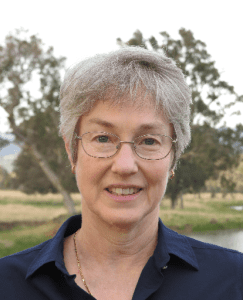
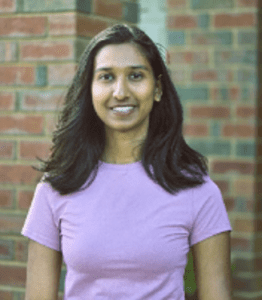
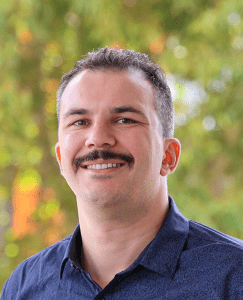
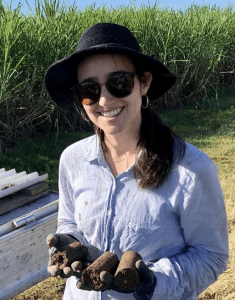
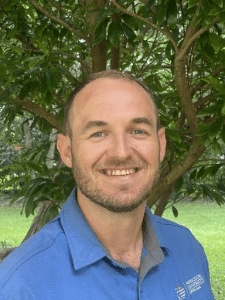
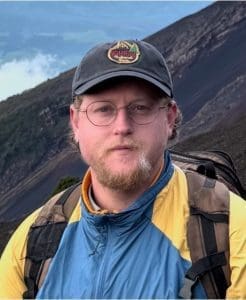
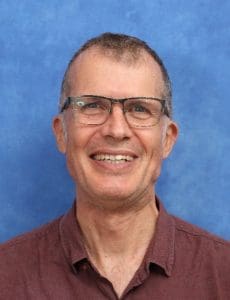
Dr Peter Almond, Head of Department, Lincoln University
Peter Almond’s research occupies the niche between soil science and the broader earth sciences. He applies his skills to understanding earth surface processes, biogeochemistry, natural hazards and paleoclimate and climate change over a range of time scales. His experience and knowledge allow him to bring a unique perspective to earth surface processes research that is complementary to other disciplines, including geology, geomorphology, geochronology, climatology. Most recently Ass. Prof. Almond has developed a research programme into enhanced rock weathering, deriving a method for quantifying CO2 drawdown suitable for the NZ GHG inventory and engaging in fundamental field-scale research to determine efficacy of ERW in pastoral ecosystems.
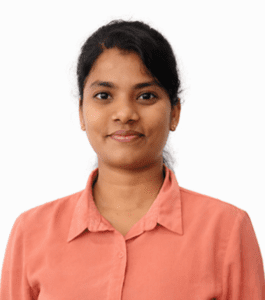
Thilini Amarasinghe, PhD student, Adelaide University
Thilini Amarasinghe is a PhD candidate in Environmental Science at the Adelaide University, specialising in enhanced rock weathering and the repurposing of silicate minerals for carbon dioxide capture and sustainable food production. She holds a B.Sc. (Honours) in Chemistry from the University of Sri Jayewardenepura, Sri Lanka, and previously worked as a Research Scientist at the Industrial Technology Institute. Her research experience spans soil chemistry, nutrient solubilisation, and analytical techniques. Thilini’s work integrates geochemistry, soil carbon dynamics, and climate‑focused mineral transformations to advance sustainable agricultural and environmental solutions.
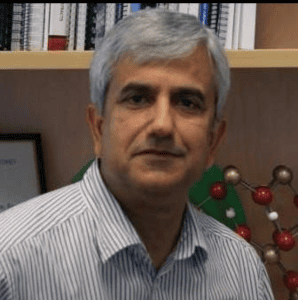
Dr Biraj Basak, Senior Scientist, ICAR - Indian Agricultural Research Institute
Biraj Bandhu Basak currently working as Senior Scientist (Soil Science) at Indian Agricultural Research Institute, New Delhi. He has more than 15 years of research and teaching experience in soil science and plant nutrition. He worked on cultivation and value addition to various industrially important crops through various agronomic and soil management practices. Among the technologies developed by him, alternative source of potassium and phosphorus enriched organic fertilizer, solubilize insoluble K from low-grade silicate mineral (first time reported from India), organic nutrient management module for medicinal crops, waste biomass valorisation are unique to mention here. He has developed two unique phosphorus and potassium enriched vermicompost, which have been patented for commercial licensing.
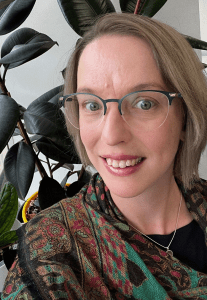
Dr Kerryn Brent, Research Scientist, CSIRO
Kerryn Brent is a research scientist at CSIRO, Hobart specialising in environmental governance, climate change law and ocean governance. Her current research focuses on the governance of novel carbon dioxide removal, examining how to manage associated risks and uncertainties, and promote responsible innovation. Kerryn holds a PhD in Law from the University of Tasmania and BA/LLB from the University of Newcastle. Kerryn’s broader research interests include law of the sea, and the governance of solar radiation management, green hydrogen and the restoration of blue carbon ecosystems.
Dr Annette Cowie, Senior Principal Research Scientist, NSW Department of Primary Industries
Annette Cowie is a Senior Principal Research Scientist at the New South Wales Department of Primary Industries and Regional Development, and has a background in agricultural science. Annette’s research sits on the science-policy interface, supporting holistic responses to climate change, and sustainable land management. Her expertise includes greenhouse gas accounting for the land sector, soil carbon management and biochar science. Annette was a lead author in the IPCC’s Sixth Assessment Report and is now co-authoring the Methodology Report on Carbon Dioxide Removal. She is a co-author of the first and second editions of The State of Carbon Dioxide Removal.
Dr Wolfram Buss, Senior Research Fellow, Australian National University
Wolfram Buss is an ARC Industry and Senior Research Fellow within the Fenner School of Environment and Society at the Australian National University. He has a background in biology (BSc), environmental and agricultural sciences (MSc) and environmental chemistry and engineering (PhD). He investigates technologies and processes to sequester large amounts of carbon in agricultural/forestry systems, which have the potential to mitigate and eventually reverse the effects of climate change while also providing soil and plant co-benefits.
Lakshmi Chamaparambil Suresh, PhD student, Adelaide University
Lakshmi Chamaparambil Suresh is a PhD student at the Future Industries Institute (FII), Adelaide University. She holds a BSc and MSc in Earth Science. Her research focuses on developing a high-precision metal isotope-based approach to quantify carbon sequestration through enhanced rock weathering (ERW). Her work includes developing and optimising isotopic techniques (e.g., Ca and Sr isotopes) in the laboratory and applying them to samples from glasshouse experiments and ERW field trials. Through this work, she aims to advance understanding of the processes controlling CO₂ and metal fluxes, improving the monitoring, reporting, and verification of CO₂ removal by ERW. Lakshmi is originally from Kerala, India.
Dr Aydin Enez, Research Fellow, Deakin University
Dr Aydin Enez is a Research Fellow from the School of Life and Environmental Sciences at Deakin University, Victoria. Dr Enez completed his PhD in 2021 (Deakin University) under the supervision of Professor Lambert Brau, with his research focus aimed at understanding novel roles of plant-microbe interactions to reduce stress in cropped plants. Since then, his research expertise has transitioned towards investigating novel, innovative, and sustainable solutions for soil health improvement. Recently, Dr Enez’s research has explored the agricultural application of Greenlandic glacial rock flour to boost soil fertility while supporting carbon dioxide drawdown in Australian cropping systems.
Hannah Green, PhD Candidate, James Cook University
Hannah Green completed a Bachelor of Advanced Science majoring in Ecology and Earth Science with a research Honours on sodic soil chemistry at James Cook University in Townsville. Hannah has remained at JCU and is now in their final year of a PhD in soil chemistry focused on optimising the use of mill by-products for soil improvement and carbon sequestration. Hannah is interested in continuing to work on improving soils, productivity, and sustainability in the future through agricultural systems modelling.
Fredrick Holden, Senior Research Associate, James Cook University
Fred Holden studied environmental science at James Cook University, where he now works as a Senior Research Associate. In this role, he manages several field trials examining the effect of enhanced rock weathering on crop productivity, soil health and carbon dioxide capture on sugarcane, bananas, avocadoes and grain in central and far north Queensland. Fred is a solution orientated research project manager, leading a large team and coordinating research activities with several commercial and research partners. His work on the effects of soil acidity on carbon capture via enhanced rock weathering had a wide impact on the industry.
Dr Thomas Jones, CERC Postdoctoral Research Fellow, CSIRO
Dr Thomas Ray Jones is an interdisciplinary researcher focused on the interactions between microbes and minerals, and how these relationships drive geochemical cycling and carbon dioxide removal. Microbes have played a central role in Earth’s carbon cycle for 3.5 billion years, and while thermodynamics determines what can happen at surface and subsurface conditions, it is microbial communities that can mediate what actually happens, and at what rate. Working within CSIRO’s CarbonLock Future Science Platform, Thomas investigates how these communities accelerate silicate weathering, carbonate formation, and nutrient cycling in agricultural soils – and how ERW might perform under the moisture-limited conditions that define much of the Australian landscape.
Dr Euripides Kantzas, Researcher, University of Sheffield
Dr Euripides Kantzas is a data scientist at the Leverhulme Centre for Climate Change Mitigation. He studies the potential of CO₂ removal through Enhanced Weathering at national scales, under different climate scenarios and macroeconomic projections. His work involves assimilating data and geochemical models in optimisation routines to estimate deployment scale, costs, and associated emissions of enhanced weathering. He also develops machine learning emulators of geochemical models to accelerate computations, and maintains databases to support data management and dissemination for research and decision-making.
Dr Sean Manning, Head of Instrumentation, GXLab
Sean is the Head of Instrumentation at the GXLab based in South Australia.
Professor Paul Nelson, Promotional Chair, James Cook University
Paul Nelson is a soil scientist who has been working at the agricultural-environmental interface for 35 years. He studies relationships between soil properties, soil management, crop productivity, water quality and greenhouse gas emissions and has published over 100 peer-reviewed papers. Over the past 25 years he has worked mostly in Papua New Guinea, Indonesia and northern Australia. His current focus is on soil carbon cycling and the effects of enhanced rock weathering on carbon dioxide capture. He works at James Cook University in Cairns.
Meila Picard, PhD student, Lincoln University
Meila Picard is a PhD student at Lincoln University interested in the role of soils for natural carbon capture and climate change mitigation. Her PhD aims to investigate the potential of enhanced rock weathering for carbon capture in a New Zealand pastoral agricultural system. This includes the implications for wider aspects of the productive system such as trace element accumulation and changes to soil fertility.
Dr Lily Reid, Research Assistant, Adelaide University
Lily Reid’s current research focusses on resolving the organic carbon storage pathways of enhanced rock weathering processes in high-value orchards. This project investigates how the application of basalt rock as a soil amendment works to potentially remove atmospheric carbon dioxide and store it within agricultural soils, while improving overall soil health and productivity. She was awarded her PhD from the University of South Australia in 2020 for her work on the palaeoecology and palaeoenvironments of the Ediacara biota. This work seeks to reconstruct past environments and employs a range of methodologies including sedimentology, facies analysis, sequence stratigraphy and detrital zircon geochronology.
Professor Balwant Singh, University of Sydney
Dr Balwant Singh is a Professor of Soil Science at the University of Sydney. His research interests include understanding the structural and chemical properties of soil clay minerals, adsorption reactions of trace elements at the mineral-water interface, phytoremediation of toxic elements, biochar and organic carbon interaction with soil minerals. Dr Singh is a co-author of globally popular ‘Environmental Soil Chemistry’ textbook; and has also co-edited two books – Biochar: A Guide to Analytical Methods and Synchrotron-based techniques in Soils and Sediments. He has been a Co-Editor-in-Chief of Soil Research journal since 2014.
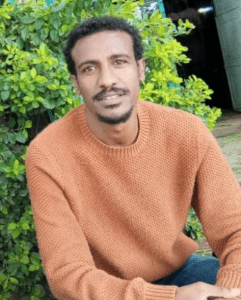
Sofonyas Tefera, PhD student, James Cook University
Sofonyas Tefera is a PhD student in Soil Science at James Cook University. His research examines how soil conditions and management influence Carbon Dioxide Removal (CDR) through Enhanced Rock Weathering (ERW), with a particular focus on soil pH, pCO₂, and the effects of different nitrogen fertiliser forms. He is a former soil science and agronomy researcher at Tigray Agricultural Research Institute, Ethiopia, where his work focused on soil chemistry, nutrient dynamics, and integrated soil fertility management. Mr. Sofonyas holds an MSc in Soil Science from Haramaya University, Ethiopia.
Yiwen Zhang, PhD candidate, Nanyang Technological University
Yiwen Zhang is a PhD candidate at the Asian School of the Environment, Earth Observatory of Singapore, Nanyang Technological University, and was a visiting scholar at the University of Cambridge. Her research focuses on enhanced rock weathering (ERW) as a scalable carbon dioxide removal solution, integrating life-cycle and techno-economic analysis (LCA-TEA) across Southeast Asia and Australia. She examines stakeholder perspectives on durable carbon dioxide removal (CDR), with a focus on ERW, through interviews that explore deployment barriers, enabling conditions, and market readiness. With a background in environmental science and economics, her work bridges geochemical processes, carbon markets, and real-world deployment to support effective and scalable climate mitigation strategies.
Symposium Registration Information- REGISTRATIONS NOW CLOSED!
Symposium fees include morning tea, lunch and afternoon tea. All fees are in $AUD. Please note: accommodation and other meals are at your own expense.
Registration Rates
Standard rate – Thursday 25 June 2026 $150 (incl GST)
Students receive 50% discount off the above rates with confirmation of current student ID and institution. Please email your request before registering to receive the promotion code.
The Symposium will be held at James Cook University, Nguma-bada Campus in Smithfield, Cairns Queensland. Just an hour from the field trial site and beautifully situated between the rainforest and northern beaches. For maps, destination travel tips and accommodation suggestions visit our venue information page.
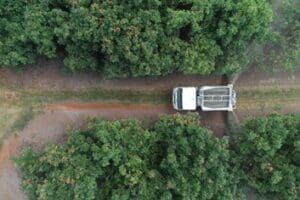
Field Visit: Enhanced Rock Weathering Avocado Trial Site
On Friday 26 June 2026, the day after the symposium, community members are warmly invited to join the project team at Howe Farming near Mareeba for a guided tour of the Enhanced Rock Weathering monitoring site.
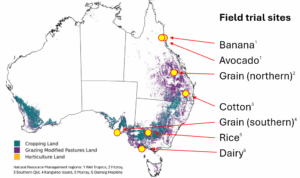
The project includes seven active field trial sites spanning Australia’s eastern seaboard and southern regions, testing Enhanced Rock Weathering across diverse climates and farming systems.
This Enhanced Rock Weathering Symposium and Field Trial Visit are supported by the Australian Government through funding from the Climate-Smart Agriculture Program under the Natural Heritage Trust.