
Building on previous research and trials, this project focuses on scaling up the use of basalt to rejuvenate depleted, infertile agricultural soils across Australia. By applying crushed basalt, we aim to supply essential nutrients, reverse soil acidification, form fertile clay minerals, and capture carbon dioxide during weathering.
These processes will boost crop growth, improve water and nutrient efficiency, enhance soil quality, and increase carbon sequestration.
On-farm demonstrations will evaluate the logistics, costs, and benefits of using locally sourced, high-quality basalt in various agricultural systems.
To maximise the uptake of this process, the project will collaborate with farmers, the Drought Resilience Adoption and Innovation Hubs, industry organisations, and a leading carbon market enterprise specialising in enhanced rock weathering.
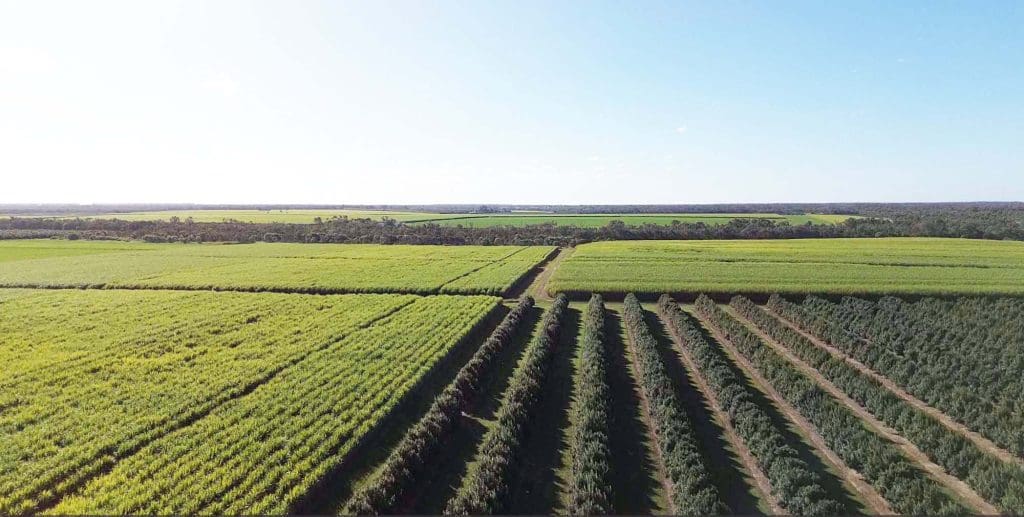
Enhanced weathering speeds up the natural process of rock breakdown to capture CO2 from the atmosphere.
When rock is exposed to water, air, and biological activity, it breaks down into smaller particles and dissolved salts. These salts either form solid carbonates in soil or flow into water systems, eventually becoming limestone. This natural process has locked much of Earth’s carbon into rock over billions of years.
Today, CO2 levels are rising due to burning fossil fuels. Enhanced weathering accelerates rock breakdown, allowing CO2 to be captured in years instead of millennia.
Crushed basalt not only captures CO2 but also:
Enhanced weathering offers a dual benefit for climate action and soil health, making it a promising tool for sustainable agriculture.

Where did the idea of rock weathering come from?
Crushed rock has been used to boost crop growth for centuries, with scientific studies on the benefits of applying crushed basalt dating back to the 1960s. The concept of using enhanced rock weathering to capture CO2, however, emerged in the early 2000s. This idea stems from a deeper understanding of how rock weathering has shaped atmospheric CO2 levels and influenced the Earth’s climate over millions of years.
Where can enhanced rock weathering be used?
Enhanced rock weathering works on any land, but it’s most effective on agricultural land. Farms are ideal because spreading machinery is accessible, and it boosts both productivity and soil health. Wetter, warmer climates see the best results, and incorporating the rock into soil through tillage could improve effectiveness, though this still needs testing.
How much carbon can be captured?
The rate of CO2 capture via enhanced weathering varies enormously according to the nature of the crushed rock, climate, soil type and agronomic management. Modelling studies suggest billions of tonnes of CO2 might be removed annually if crushed basalt was applied to croplands globally. With current energy-related emissions at 37 billion tonnes a year, this means enhanced weathering could contribute in a big way to reaching net zero emissions.
In Australia, current modelling by the Leverhulme Centre for Climate Change Mitigation suggests that 2-20 million net tonnes of CO2 might be captured annually by 2050 if basalt was applied to cropland in eastern Australia. Current CO2 emissions from Australian agriculture are about 13 million tonnes per year, so enhanced weathering has the potential to off-set them entirely.
Current estimates of CO2 capture via enhanced weathering range from 0.02 to over 10 tonnes of CO2 per hectare per year. For comparison, the average Australian passenger vehicle emits about 1.81 tonnes of CO2 per 10,000 km.
How is carbon capture measured?
Carbon capture is measured by testing soil, drainage, and runoff for bicarbonate and carbonate through lab analyses. While this method is costly and complex, simpler approaches are needed for large-scale use. Currently, a mix of soil testing and modelling is used to monitor results in commercial-scale projects.
Do the benefits of enhanced rock weathering outweigh the costs?
Applying crushed basalt to soil has unequivocal benefits for soil health and plant growth, as our best soils were formed from weathered basalt. However, to achieve a net positive benefit, the costs of enhanced weathering, in terms of dollars and CO2 emissions, need to be less than the benefits. Costs include mining, crushing, transporting, spreading, brokerage and auditing. The benefits and the costs are still largely unknown, but they will depend on rock type, climate, soil type and cropping system. This project aims to quantify the benefits.
How much research is currently happening in this space?
Research on enhanced weathering for CO2 capture started in the late 2000s, and the first field trial in Australia was established in 2018. The number and diversity of research projects on the topic has ballooned since then, with research projects on all continents and in many cropping systems.




The Agricultural Reference Panel is made up of representatives from Grains Research and Development Corporation, Hort Innovation, Sugar Research Australia, and Meat and Livestock Australia.